Skydiving Terms That Sound Like Sex Acts (But Aren’t)
"I spent the whole debrief explaining what a Rear Float is. She didn't believe me."
Skydivers have always had a language problem. Not in the sense that we struggle to communicate, we're perfectly capable of that. The problem is that the terminology our sport has developed over decades sounds, to any non-skydiver within earshot, like an extremely "adult" conversation.
This is not our fault. Mostly. The physics of freefall just happened to generate vocabulary that also maps directly onto what happens when the altimeter reads zero.
So here, as a public service and because someone had to do it, is a completely legitimate glossary of real skydiving terms that will make your woffo friends have many follow-up questions.
Actually means
A ground rehearsal of a skydive. The team walks through the entire jump on the floor before boarding the plane, usually on creepers, running every point in sequence to build muscle memory.
Every serious formation team dirt dives obsessively. You're flat on the ground, grabbing grips, shuffling across the hangar floor, running the same sequence over and over until it's automatic. The name is completely standard. It is also the first thing every new jumper has to say out loud to a non-skydiver and watch their face.
“We dirt dived it six times before load. Still fell apart on point four.”
Actually means
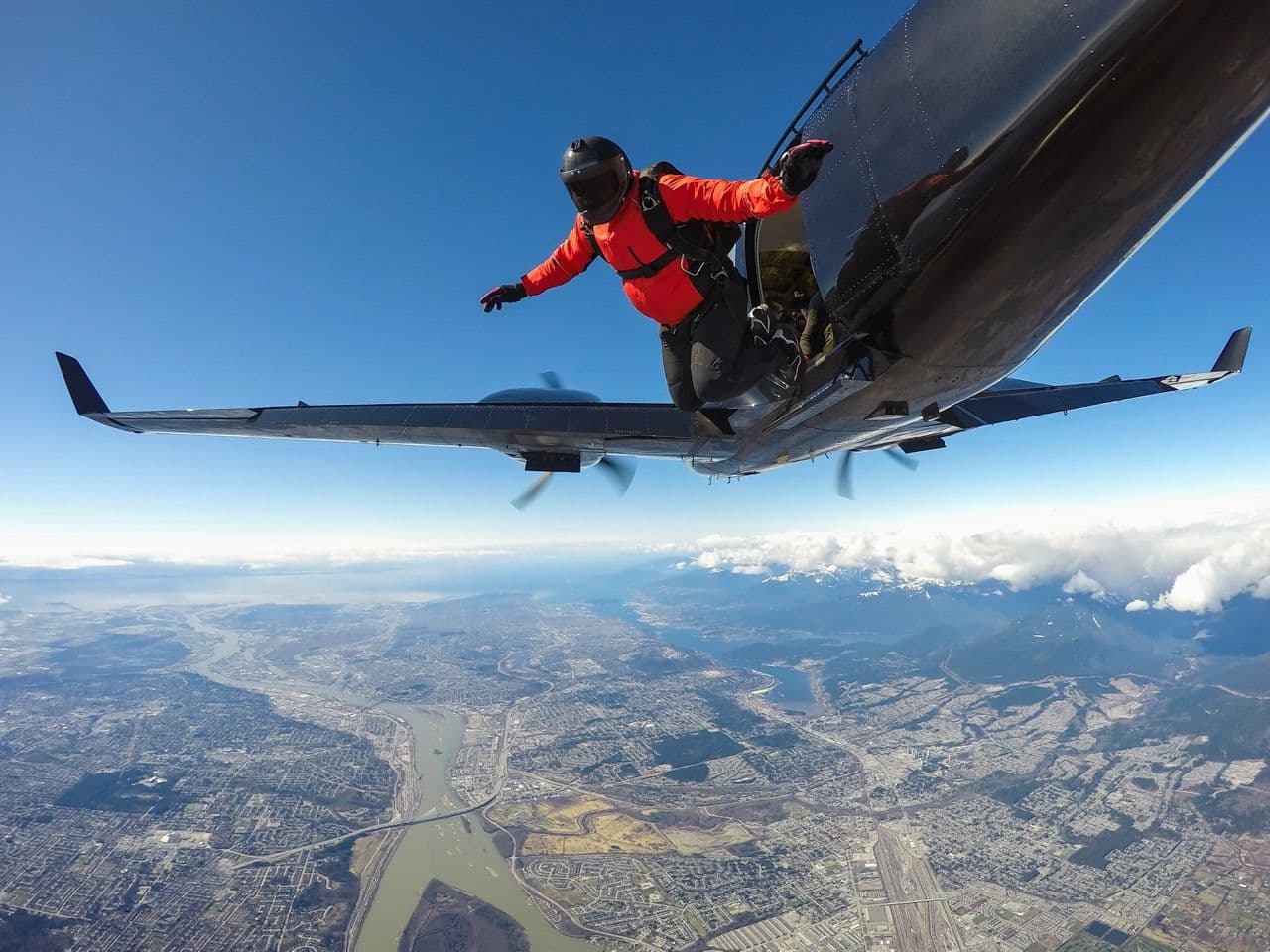
A jump run exit position where a skydiver hangs off the rear of the aircraft door, facing forward, before launching.
The rear float is a classic exit position. You're dangling off the back of the door, knees bent, looking inward at the rest of the team. The name is completely clinical. The sound of it is not.
“I had Chelsea on the rear float. She's got a solid exit.”
Actually means
A rotation in the vertical axis where a skydiver spins in place typically performed sitting or head-down while maintaining heading awareness.
In freefly, a helicopter is a controlled spin around your own vertical axis. It requires hip drive, shoulder counter-rotation, and enough body awareness not to send yourself into a corked mess at 140mph. Sounds straightforward. Reads differently to a stranger.
“He dropped into a helicopter right in front of me. Didn't even warn me.”
Actually means
A thin leather or cloth open-face helmet worn by jumpers offering no real protection, used mainly to hold audibles and keep the wind off your ears.
A frap hat is what you wear when you've decided a full helmet is too much commitment. It sits loosely on your head, barely stays on in freefall, and its name sounds like something you'd see workshopped on a late-night comedy show. The origin is unclear. The connotations are not.
“Left my frap hat in the manifest office. Someone's always playing with it.”
Actually means
The area of turbulent, low-pressure air that forms directly above a skydiver in freefall. Other jumpers flying into your burble can lose relative velocity and close fast a significant safety consideration in formation work.
Getting into someone's burble is a hazard. It sounds like a politely euphemistic thing a children's TV presenter would say. On a 16-way, it can ruin your jump. Treat it with the respect it deserves, despite its ridiculous name.
“I came in high and got right in his burble. Lost all my fall rate in half a second.”
Actually means
A specific position in a formation your assigned place in the skydive. "Flying your slot" means holding your correct position relative to the base.
Every skydiver has a slot. Sometimes you get a good slot, sometimes a bad one. Experienced jumpers talk about finding the slot, flying the slot, holding the slot. Beginners talk about struggling to get into the slot. All of this is completely normal conversation at any dropzone in the world.
“She came in from outside and just took my slot. Didn't even ask.”
Actually means
Making contact with another jumper's grip point with more force than intended approaching too fast and slamming in rather than floating into the formation cleanly.
Every formation jumper has hard docked someone. You come in a bit fast, misjudge the closure rate, and instead of a smooth, controlled approach you arrive with intent. It throws the formation, it's embarrassing, and it gets called out in the debrief every single time.
“Sorry about that. I hard docked you on point three. Came in way too hot.”
Actually means
A flat, wheeled board that skydivers lie on during dirt dives to simulate freefall body position while rolling across the hangar floor. Standard kit at any serious formation dropzone.
The creeper is an entirely innocent piece of training equipment. You lie on it face down, arms out, and get pushed around the hangar by your teammates while pretending you're at 10,000ft. Telling someone you spent your Sunday morning on a creeper, getting worked by your coach, is a sentence that requires significant context.
“Coach had us on the creepers for an hour before we even talked about the plane.”
Actually means
The fabric handles sewn onto a jumpsuit specifically to give other skydivers something to grip during formation work. Strategic placement is important.
Grippers are a key piece of kit. You need good ones in the right places. If you don't have grippers where people expect them, the jump falls apart. Jumpsuit manufacturers put serious thought into gripper placement. Experienced jumpers are very opinionated about theirs.
“Nice suit, where are your grippers? I couldn't find them in the debrief.”
Actually means
A formation where one skydiver sits on top of another's deployed canopy during freefall or under canopy. Also used informally to describe any chaotic, out-of-control jump where someone's getting thrown around.
A rodeo is exactly what it sounds like, a high-adrenaline skydive where someone, skydiver (the "jockey"), rides on the back of another wearing a wingsuit (the "horse"). The fact that this is also an informal description of a generally rough ride only adds to the poetry.
“That jump was a full rodeo from 10,000ft. I had no idea what I was doing.”
Actually means
Non-skydivers. Origin: the classic phrase "Wuffo you jump out of a perfectly good airplane?" Used affectionately and otherwise to describe anyone who doesn't jump.
This one doesn't sound like a sex act so much as a very specific request. It appears at the end of this list simply because explaining to someone at a party that you spent the weekend sorting out wuffos is a reliable way to end a conversation fast.
“The DZ was full of wuffos this weekend. Tandem hell.”
There are more. There are always more.
Any sport that involves the words "penetration" (a canopy's ability to fly forward against the wind to reach a target landing area), has no shortage of material.
Use responsibly. Or don't. Your debrief, your call.