Every landing pattern is the same three legs. The size is what changes.
Ask ten jumpers at any UK dropzone to describe a landing pattern and you will get the same answer ten times. Downwind, base, final. Nobody gets that bit wrong.
Ask them how big it should be today and the answers scatter, because that is the part nobody teaches you directly. You learn it by getting it wrong, landing out, and adjusting next jump. Which works, eventually, at the cost of a season of long walks back.
The simulator above is that adjustment loop with the walking removed. Everything below explains what it is testing.
The pattern is three legs and two turns, and that is the whole shape
Leaving your holding area at around 1,000ft you fly the downwind leg, with the wind behind you, running parallel to the direction you intend to land. Somewhere around 500 to 600ft you turn onto the base leg, which crosses the wind line. By 300ft you turn onto final, into wind, and fly it straight to the ground.
Two turns of ninety degrees. A hundred and eighty degrees of heading change in total, and nothing else. If you are turning more than that, you are correcting rather than flying a pattern, and every correction moves you sideways off the line you meant to fly.
British Skydiving teaches the final turn height as a hard priority over the final turn position. Being in the right place at 200ft is worth nothing if the canopy has not finished recovering from the turn.
The final leg is a fixed length and the wind decides it
This is the piece that catches people out, and it is not obvious until someone says it plainly.
A modern sports canopy on full drive glides at roughly three to one. For every foot you come down you go three feet forward. Turn onto final at 300ft in nil wind and you will travel about 900ft before your feet touch. That distance is not a choice. It is arithmetic.
Now put wind under it. The canopy still moves forward at the same speed through the air, but the air itself is moving backwards over the ground, so your distance over the ground shrinks:
- Around 4mph: final leg roughly 735ft
- Around 8mph: final leg roughly 570ft
- Around 12mph: final leg roughly 405ft
Which means the same pattern flown on two different days puts you in two different places. Turn onto final 700ft out in a 12mph wind and you will land 300ft short, no matter how well you fly the approach. There is nothing you can do on final to fix a final that started in the wrong place.
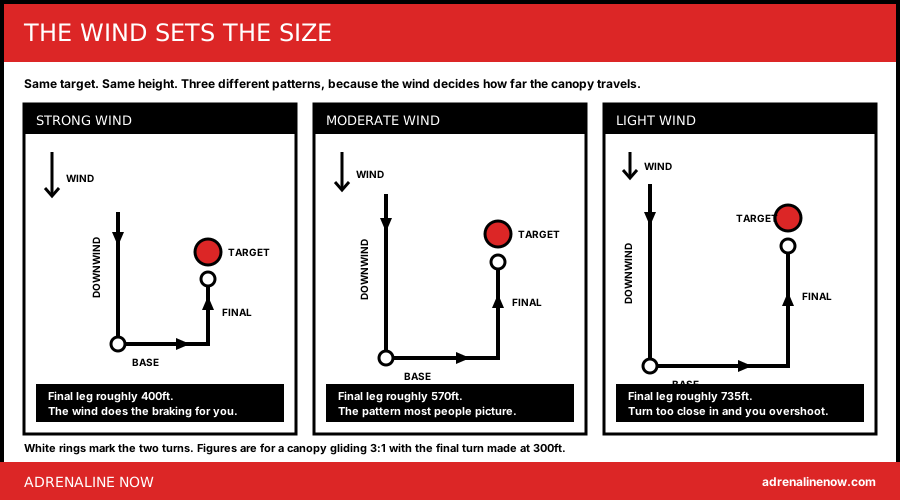
The practical version: the stronger the wind, the tighter everything gets. Base turn closer in, shorter downwind leg, shorter final. In light wind the whole thing stretches out and you need to commit to a base turn much further from the target than feels comfortable.
The base leg is where the drift gets you
On the downwind and final legs you are pointing along the wind line, so drift shows up as speed. On the base leg you are across it, and drift shows up as the ground sliding sideways underneath you.
Aim straight across and you will not go straight across. You will crab, and you will arrive at your final turn further downwind than you planned, which makes the final leg longer than it should be, which means you land short. That single mechanism accounts for a large share of students landing off the target.
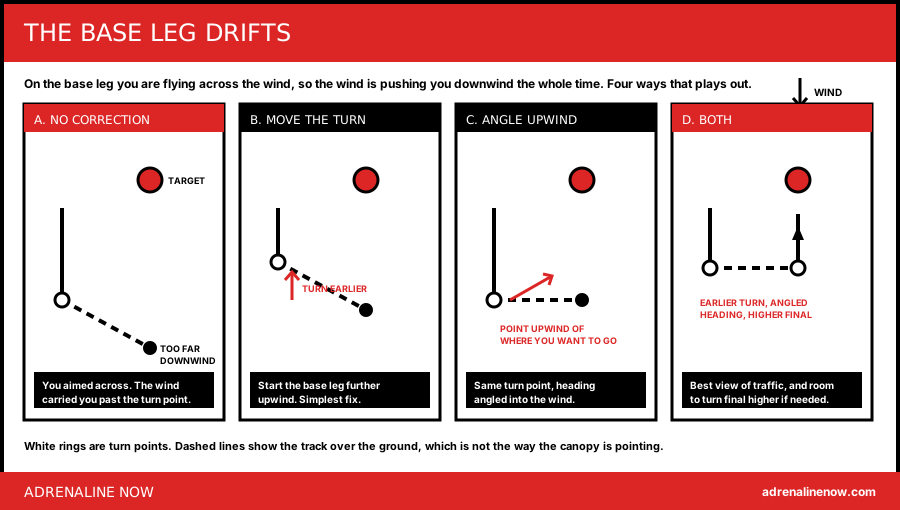
Three ways to deal with it, and the fourth panel combines the useful ones. Move the turn point further upwind. Angle your heading into the wind so your track over the ground goes where you wanted. Or do both, which also leaves you looking into the traffic and with height in hand if you decide to turn final early.
Every turn costs height, and the cost is not linear
A flat turn is cheap. A steep one is not, because a banked canopy is partly flying sideways and its descent rate climbs sharply with bank angle.
Two ninety degree turns flown flat cost around 85ft in total. That is the price of flying a pattern at all. A single hard 180 costs more than both of them together.
This is why the low turn rule exists, and it is worth stating as physics rather than as a rule. A canopy in a steep turn is descending fast and needs height and time to recover. Make that turn at 400ft and you will get away with it. Make the same turn at 150ft and there is nothing left underneath you.
If you are pointing the wrong way at 200ft, land it
The trade that hurts people is not the downwind landing. It is the turn made to avoid one.
Landing downwind means arriving faster than you wanted. It is uncomfortable, it usually means running it out or taking a slide, and occasionally it means a bruise. Turning hard at 200ft to avoid it means arriving under a diving canopy with no height to recover, and that is a different category of outcome entirely.
The simulator scores it that way deliberately. Arrive at 300ft already pointing the wrong way and land it, and you keep full marks for the decision. Turn to fix it and you lose more than the downwind landing ever cost.
What this cannot teach you
It is a plan view of an empty sky. There is no traffic in it, and finding other canopies is most of what you are actually doing on a busy Saturday. There is no wind gradient, so the wind does not drop off near the ground the way it really does. There is no real landing area, with its fence lines and its hangar turbulence and the particular tree everyone uses as a base turn marker.
It cannot tell you whether you are current, and it is not built to. If you have had time off, that conversation is with your chief instructor, not with a browser.
What it does do is let you fly a hundred patterns in different winds in an afternoon and find out whether you can predict where you are going to land before you get there. That prediction is the actual skill. Everything else is steering.
Worth reading next: our wing loading calculator for where your canopy sits, and the canopy size chart for what British Skydiving Form 330 allows at your jump numbers.